
This one’s going to be long. It may also ruffle some feathers. I’m okay with that.
Hip-hop tends to, even when it gets down to the grimiest parts of life, still have inklings of positivity or knowledge within it. People may look at me funny, considering Dee-1’s Drink Champs appearance. They may even consider me an agent, which is stupidly far from the truth. However, I’d consider artists and groups like Ice-T and NWA hip-hop artists (and not just “rappers”) when they first dropped. While their music wasn’t all that “positive,” they offered tales of situations that could arise in their area. For me, that’s because of their discussions about gang life, how it wasn’t a long life for someone who “wanted” to be a gangsta and the life itself was forged out a necessity due to systemic racism. Was it “positive” to hear “6 in the Mornin’, police at my door?” No, obviously not. But it was a reality that some folks dealt with, either through their own trappings or through just being in the wrong place at the right time. There’s this little thing called nuance that’s missing in our world today.
The thing about hip-hop is that there’s always a balance and a heavy dose of nuance. For every “Ain’t Gonna Hurt Nobody,” there was a “F*ck the Police.” For every “F*ck the Police,” there was a “Me Myself and I.” For every “Me Myself and I,” well, I think you get the point. There are a lot of different songs over the decades that fall in a variety of topics and subtopics, from the ’80s to today.
I will agree that hip-hop radio, especially in 2026, needs more of that balance, that nuance. There’s less of a message and more of a focus on catchiness and repetition. That’s not a bad thing, because catchiness and “radio singles” have always been a part of the game. Rap and hip-hop are, well, built on rhythms. That said, there’s not as much of a balance these days on the radio. Even as recent as the early 2010s, there was more of a mix between the radio singles, the somewhat more conscious-leaning songs, the party tracks, the gangsta rap, and so on. In 2013, you could go from “Crooked Smile” to Chief Keef to Jay-Z to Flo Rida’s “Low” still getting a random spin here or there. Again, there was more balance. That’s not really the case in mainstream radio.
To say that there’s not balance at all, though, is short-sighted. To say that we’re all just being poisoned is removing agency from the individual. There are a lot of varying styles of the genre we love and it’s truly not that hard to find them. It’s not even an issue of “you just have to know where to look.” If you log into social media even, you’ll find artists like Rian Wyld spitting her truths about Timbaland as often as you’ll find a Sexxy Red. Yes, the algorithms lean towards popularity (read: radio stuff). But “conscious” rap, while it’s not on the radio ad nauseum, isn’t exactly all that unpopular. You’ll find a more-conscious male rapper in the mix between the “Janice STFU” memes and whatnot. It’s all there, people just have to actually engage with it.
People got mad at India Arie because she was telling the truth, even if people misconstrued her words. She said that she wasn’t a fan of stuff like “Spend Dat” and would prefer more diversity and more uplifting messages in music. However, she also said she wasn’t going to boycott the song. In so many words, she laid it out there in two ways. Yes, these labels are promoting foolishness, but it’s ultimately up to the consumer to actually engage with something different.
(Ed. Note: To view more of India Arie’s comments on the song, the vibes, her own story and more, visit her Substack. She explains it more in depth than I do. Additionally, the way that the industry has done India Arie is terrible, but that’s another story for another time. Spoiler alert, it does involve colorism.)
If they’re tired of the Yung Miamis and those types, engage with a Sa-Roc or Raina Simone or a Rapsody or whoever, really. At least that’s how I took Ms. Arie’s words, so I admit I could be wrong. Additionally, I believe that people can enjoy what they enjoy and shouldn’t be subjected to hearing that they’re “brainwashed” or “braindead” because of it, but be aware of the “negatives” that may come with it. I mean, I like the Persona video game series. Does that mean I’m going to put a gun to my head and try to summon an otherworldly entity? Hell no, but I understand that Persona isn’t something I should mimic, even if I think Joker’s cool. I liked The Boys. Does that mean I agree with Homelander because he was the focus of the show? Again, hell no. Accountability is key.
Now when it comes to Dee-1, I get the idea of what he’s saying.
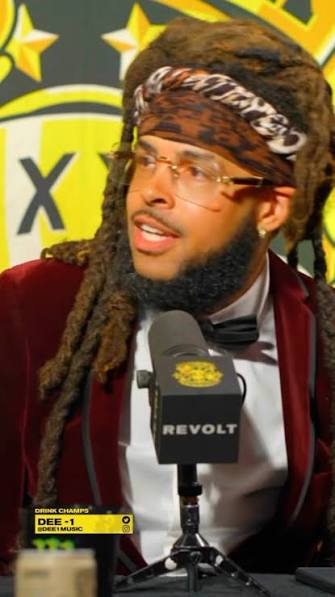
No, gangsta rap wasn’t “positive” and showed a side of Black and inner-city life that wasn’t necessarily pretty. I also get that gangsta rap may have some on the outside assuming that all rappers are like that. That said, I don’t agree with the idea that NWA marked the decline of hip-hop and Black positivity. I don’t believe that gangsta rap destroyed the community. Again, there’s still a healthy helping of positive, inspirational music. There are still heavy amounts of people doing “The Lord’s Work,” even if they’re not wholly in the church. There are community leaders and activists who still help their people and uplift them even when NBA Youngboy is out here doing whatever. It’s short-sighted and, in some ways, ignorant to even insinuate that it’s like consciousness suddenly “died” when people starting “grab[bing their] d*cks if they lov[ed] hip-hop” or started busting shots at crooked cops or started screaming “THUG LIFE” or whatever. But, again, I do agree that we need accountability in the world, but not just in music.
It goes both ways. We need rappers to accept that they are, whether they want to be or not, looked up to. But, it’s not just on rappers. Depending on Boosie Badazz to be a positive influence on your kids and actually own his life’s worth of foolishness likely won’t happen. And if it does happen, know that it’ll likely be the absolute last resort he has. Either that or he’ll worry about nails over his pleading with The Orange Regime for a pardon, but I digress. Additionally, depending on the record labels to promote positivity more over crap damned sure won’t happen, so we’ve got to do it ourselves. So instead of just focusing on the rappers or the labels, we as a people must get together and actually tackle the problems where they lie: at home and in our communities.
We all have got to do better and not just take the easy way out and blame “the culture.” That’s what white people did during the whole “Satanic Panic” brouhaha in the 1980s. Putting the blame on this genre, or this game or this person or that show or whatever is narrowminded–even if there’s a bit of truth to your critiques. Violence and sexual content have been a thing before rap and will be a thing after rap. Things that take us “further from God” existed before Dee-1 or I walked this earth, and they’ll exist long after both of us meet our maker. But, it starts with acknowledging that, even among the “bad,” there are likely more people who are doing good in their communities than doing foulness.
For example, I live over West Baltimore, in an area that’s right around Park Heights and Northern Parkway. People who know Baltimore know exactly what I mean by this, especially back in the day. Is it all sunshine and rainbows? No. However, there are a lot of people who are working to make it a solid place to live, to raise families in and not just be reminiscent of the Bodymore days of old. Hell, even during the days of old, I never felt “afraid” to be around the city.
On that token, I see people in Baltimore and elsewhere up-in-arms over “teen takeovers,” which are essentially flash mobs of Black and Brown kids. I get why they’re problematic, I do. But many of the critiques end up going the way of “what’s the City doing to stop this?” It’s far less about what Mayor Brandon Scott provides the youth (which is a lot if people actually look for it). It’s more about parents being parents and actively seeking out these alternatives to mass group meetups. You want to blame someone, blame the parents and get them to step up. Again, accountability isn’t a dirty word, my friends.
And neither is hope. Let’s focus more on the parents who are actually parenting versus the so-called “bad apples.” Let’s not sweep the negatives under the rug at all. Let’s acknowledge them, but instead of solely focusing on what’s wrong with the world, shine even more light on what’s actually going right. For every hood n*gga anthem, there’s three songs online that are inspirational (kind of making up that number, but go with it). For every robbery or youth “disturbance,” there are many more stories about kids and teens getting together to just be kids. For every “Spend Dat,” there’s an alternative. To change the narrative surrounding Black people, we ourselves have got to force it to change and actually focus on some of the good in the world. We can’t depend on a rapper or a mayor or a president to do it. We have to be the change we seek. I get it, the world is terrible. It sucks, in some ways. However, there’s still reason enough to say “hey, it ain’t all that bad.” They say you’ll catch more flies with honey, after all.
Again, I agree with a lot of what Dee said in his interview. I also agree with India Arie in a sense. I may not wholly agree with the how, but I get the point. I also think that we’ve got to take more responsibility in guiding our youth–rappers and otherwise. No, Black people are not a monolith. We come in all shapes and sizes and experiences. What I went through isn’t what you went through. What you go through isn’t necessarily what the next person went through. We just need more balance and more diversity in our views of Black culture and Black people as a whole. It can’t all be super-positive, but it damn sure isn’t all negative, either.


