
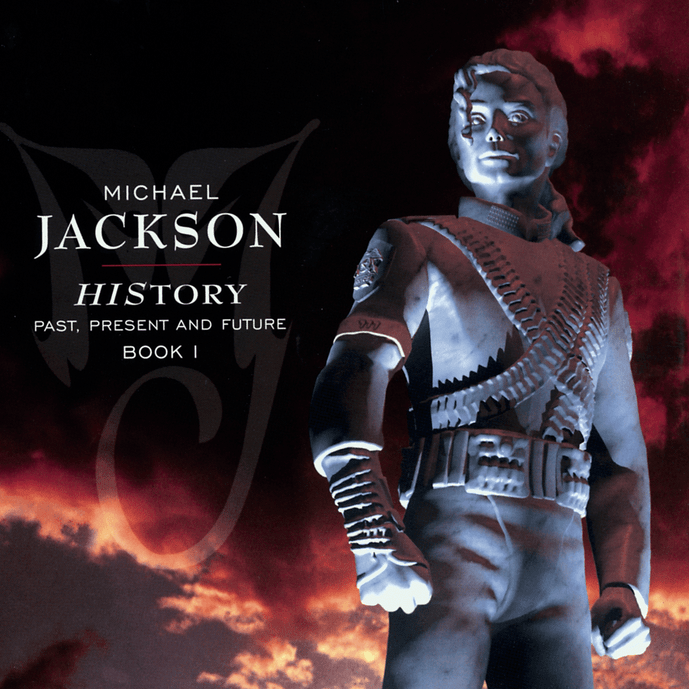
I’ll keep this under 2,000 words because some don’t read as much as they should. If anyone’s paid attention to me, you’ll have noticed something when it comes to Michael Jackson discusssions. That is, I’ve made mention over the last few years that his 1995 HIStory album is bloated. That mainly had to do with its length, not really with the subject matter. After giving it a few “with fresher ears” listens over the last two months, I think I’m ready to give some thoughts about it.
TL;DR: HIStory is long and a tough listen for anyone if they go end-to-end. However, both sides are needed to appreciate the second half of the album, HIStory Continues, which delivers some of Jackson’s most-personal–and most-revolutionary–songs.
A double album, HIStory features 15 songs from the Off the Wall to Dangerous era, HIStory Begins. Disc two features 15 new songs, the aptly titled HIStory Continues. Disc one somewhat serves as a reminder of why Jackson was seen as the King of Pop. Given the timing of HIStory‘s release (1995, right after the allegations started stirring), I understand why it was “needed.” It was a proper reminder to fans and newcomers alike of Jackson’s artistry and flair. He wasn’t tabloid fodder. No, this was the daggone King of Pop. That said, it’s also a “to-the-point” sampling of some of Jackson’s biggest hits between 1979 and 1991, with the usual suspects. And while Begins is a somewhat soft lead-in for the angrier stylings of HIStory Continues, it does its part to showcase the full extent of Michael Jackson’s genius.
After “Heal the World” finishes, though, that’s where the fun really begins.
On HIStory Continues, we get 15 songs of Michael flipping the bird to naysayers, critics and haters. Continues kicks things off with “Scream” and its incredible (and incredibly-expensive) video. I absoutely love hearing the defiance, anger and even further maturation Jackson exhibits throughout the project. That’s portrayed extensively in “Scream,” the only official time we hear Janet Jackson and Michael together (outside of background vocals on “PYT”). Those sometimes-guttural screams, from the Jacksons and from Akira alike, weren’t for nothing. After all, this is a man who’d, at the time of HIStory‘s release, had given almost his entire life to entertaining people, making them happy, being a light in the dark, and doing his part to heal the world.
This was a man who tried to promote love, peace and understanding all while dealing with”The Machine and its attempts to tear him down. Be it through allegations, rumors, the whole “Wacko Jacko” thing or what have you, this was a man who finally had enough. On Continues, we didn’t just get the same ol’ Michael Jackson who wanted to just motivate and empower everyone else. No, this was a man who literally says for people as a whole to “stop f*cking with him.”
He takes the vibes of, say, “Leave Me Alone” and takes his tongue out of his cheek, almost biting the damned thing in the process. Throughout the album, Michael shows us that he’s, in a word, pissed at The Machine–and rightfully so. For example, we have songs like “D.S.” and “They Don’t Care About Us,” both of which dealt with racism, corruption, ignorance, brutality, people delving into tearing others down, and controversy as a whole.
Speaking of controversy, this is the first and last time I’ll talk about the original lyrics’ use of “the k-word.” That lyric was, seemingly, brought up as much as the song’s overall message. I’m not Jewish, I am Black and not part of an “organized” religion. I don’t think MJ was being antisemetic in his use of the word. That said, I dislike when non-Black people tell me what to be offended about. So I’m not going to get on SOTB and say Jewish people didn’t have a right to feel however they felt.
I will, however, say this. Unlike George Floyd jokes, people online referring to Black people speaking about injustices as “ch*mping out” or people “planking” to imitate Trayvon Martin, MJ didn’t have a track record of being racially/ethnically/religiously insensitive. Regardless of their backgrounds, Jackson was a person who tried to uplift everyone who needed it. There is an incredible piece on Jackson’s revolutionary spirit, including a discourse about “Palestine Don’t Cry” that I suggest you all read. The piece discusses Jackson’s revolutionary leanings, from that unrecorded song to Jackson’s entire career–including “They Don’t Care About Us.” Simply put, Michael Jackson, flawed in his approach or otherwise, was a person who loved humanity. He loved humanity, even when some tried to tear him down.
And that, my friends, is all I’m ever going to say about Jackson’s original lyric choice. Don’t ask me to talk about it again.
Getting back on track, on HIStory Continues, listeners were also treated to the first of two Michael Jackson/Biggie collaborations, “This Time Around.” I do wish Jackson collaborated with more rap artists while alive. However, I get why he may not have. “This Time Around” is a great song, one which deals with both artists’ views and troubles with being stars. I enjoyed this one because it also shows Jackson almost laughing at how the world kept trying to bring him down. In response, Jackson let it be known that, well, he wasn’t “takin’ no sh*t”–especially from the people who thought “they really had control of [him].”
On the other side of the rappity-rap, we got a Shaquille O’Neal appearance on “2 Bad.” That cut featured even more of Jackson being honest with himself and his critics. It’s the perfect companion to “This Time Around,” as “2 Bad” feels like a spiritual successor to his 1987 classic one moment, defiant crotchgrab to doubters the next. Plus, say what we will about Shaq’s rap career, the brother had bars and was probably the best NBA player-turned-musical-artist this side of Wayman Tisdale (or Dame Lillard if we’re not counting that AI’s album was shelved).
Now if only they’d rerelease the Ghosts video, which features choreography for “2 Bad.”
But even as “big mad” as Jackson sometimes seemed on disc 2, he didn’t lose himelf in the process of venting his obvious frustrations with the world at large.I think that’s what keeps HIStory (specifically the Continues portion) from being just an album of jadedness and anger. It also goes back to Jackson, at his core, being a revolutionary who fought with love instead of bullets. Songs like “Earth Song,” “Stranger in Moscow,” the autobiographical “Childhood,” and the (unfortunately) R. Kelly-penned “You Are Not Alone” are examples of this. This is an album that gives us a deep dive into Jackson the man, and breaks down a lot of the myth behind his mystique.
This may not be the Michael Jackson album to put on when you or I need an MJ fix. It’s, in some ways, a tough listen. Acknowledging that the album is 30 songs, it’s not a tough listen (just) because of its length. Instead, I feel that the “toughness” has a lot to do with HIStory being one of his most-personal albums and, at times, his most-revolutionary. That’s especially true of its second act. It’s one that gets into what made Michael, Michael–and not really “The King of Pop.” It’s an album that, even with its length, is perfectly balanced between soft and harsh, angry and hopeful, pissed off and joyous, reflective and introspective, saddened at the losses Jackson’s felt and thankful for what he’s been able to do and see. It also flies in the face of who “we” thought Jackson was. Instead, HIStory was a project where Jackson let it be known who he, himself saw himself as, not as a King of Pop or a God-like entity or a martyr, just a man who was tired of The Machine beating him–and others like him–down.
If one looks at HIStory as one extensive collection of songs that’re split 50/50 between old and new, most listeners will burn out by the time the Charlie Chaplin-affiliated-and-homaging “Smile” ends. I wouldn’t blame you. Again, 30 songs is a lot to listen to at once. If you listen to just the Continues side, you won’t get burned out as quickly. However, you kind of need a working knowledge of Jackson’s pre-1995 music to apprecite what Jackson does on HIStory Continues. Granted, most of us do at this point, but I figured I’d still point that out. As HIStory‘s full title is HIStory: Past, Present and Future, Book I, that’s kind of a no-brainer, I know. But yes, it’s still a long album if listened end to end.
But, as of June 30, 2026, I have a hard time saying it’s “bloated.” It’s definitely an album that you learn to respect more given, well, its history. If I had to compare it to anything, I’d say it’s along the lines of What’s Going On, Marvin Gaye’s seminal classic. It maybe didn’t move the needle in the same exact way.
However, HIStory is an album that’s just as important to Jackson’s discography as What’s Going On is to Marvin’s.


